Showing posts with label history. Show all posts

Sunday, August 28, 2011

Today I Remember

In May I joined a couple of classmates and cool folks in Jackson for a 50th anniversary commemoration of the 1961 Freedom Rides.

DSC_1114
{Oh look! It's Charles, Lindsay and me with Joan Mulholland!)

But, as today is the 48th anniversary of the 1963 March on Washington for Jobs and Freedom, I will gladly leave reflections on the Freedom Rides themselves for future (well, and past) posts. I'll let the March get its due spotlight. It was, after all, a groundbreaking event.

I'll maintain, though, that while there were many singularly groundbreaking moments of the movement, no one moment stands alone.

(Anyone who tells you otherwise is just trying to sell you a book...I'm looking at you, Ray Arsenault, Eric Etheridge, Andy Lewis). (They've each admitted it, I'm not just taking cheap shots out of nowhere!)

DSC_1127

{you, too, are now looking at Etheridge and Arsenault}

Even the March on Washington relied heavily on much precedent.

Especially the March on Washington relied on precedent, really. (The history major in me really wants to expound on this assertion, but I'm doing my best to keep it simple stupid [per the advice of the great Michael Scott}).

I went as far as to say that the 1927 Flood of the Mississippi River helped pave the way for the Civil Rights Movement Proper (largely considered as lasting 1955-1968) in my senior thesis, so I'm big on credit sharing.

The marketing people for all the MLK, Jr. specials around this time don't have the liberty of sharing credit, as they-- much like the authors mentioned above-- have persuasive theses to put out that must come across clear and concise if they have a chance at an audience.

I have no standard of the sort to keep up around here-- clear and concise flew out of the window forever ago. Just ask any one of my professors. Given the implied trade-off (re:audience), they might be the only people left to ask, and only because they were paid to stick around.

The advantage of lower standards, in this case, is the opportunity to celebrate someone other than King for the achievement that was the March on Washington. (Which is almost blasphemous for a girl that pledge allegiance to his dream every weekday of my elementary career).

Oh, yes, I'll let the March have the spotlight today. I won't make it share with the flood or the Freedom Rides or anything.

King? He's gonna have to share. I'm able to live with my blasphemous self only because I think if he was alive-- the responsibility of remembering his involvement in the CRM left a little less to the in-need-of-a-simple narrative media-- he'd be the first to offer a speech acknowledging the others who made his success possible.

This is not just the anniversary of the "I Have a Dream" speech, after all. (Though how do I love thee? Let me count the ways...)

Today I'm remembering-- in addition to King, Randolph, Lewis, Wilkins, Young-- James Farmer.

If that seems like a contrived effort on my part to find a common denominator between the Freedom Rides and the March to focus on, then

a. there might be a little truth behind your accusation
b. joke's on you.

It's entirely to James Farmer's credit that there is such a common denominator. He did all of the work involved in being linked so closely to two of the greatest Civil Rights initiatives.

All of that work and yet, unlike King, so little credit.

Why don't you hear about Farmer in discussions on the March? So glad you didn't ask asked.

In short, Farmer was out doing the work necessary for King's dream to become yours and my reality. (Not that King didn't put in his own elbow grease, and not that Farmer was the only one getting work done that day).

(That last parenthetical disclaimer is why I'll never sell books or television specials).

On August 28, 1963, James Farmer sat behind bars in Louisiana.

An unwavering believer in the nonviolence model of Mohandas Gandhi, Farmer was in Louisiana leading peaceful protests. There, state troopers went door to door hunting down Farmer. He only escaped the city of Plaquemine by the kindness of a funeral home director friend, who smuggled Farmer out of town in a hearse as the oft-described "larger than life," deep-voiced Civil Rights leader played dead in the back.

"I was meant to die that night," Farmer later said. "They were kicking open doors, beating up blacks in the streets, interrogating them with electric cattle prods."

Out of that town and away from the immediate danger of mob violence at dark (a mob led by no less than the state troopers), Farmer was soon arrested for disturbing the peace. It was not, given the Freedom Rides (this is a contrived insertion of the Freedom Rides) and decades of experience, his first charge for breach of peace.

He refused the insistent advice of friends and colleagues that he should bail out early, in order to appear at the March. On the principle of "jail, no bail," he stayed to watch the March behind bars.

Floyd McKissick, a Congress of Racial Equality colleague read Farmer's speech aloud at the March. The protests would not end, Farmer wrote, "until the dogs stop biting us in the South and the rats stop biting us in the North." It might have been less overt, but racism in the north was no less biting. The assertions surely lost something without Farmer's booming voice.

Ultimately, his decision to stick to his guns and hang on to his pride cost Farmer a lot of glory.

(Unless you consider a bust in the center of the University of Mary Washington Campus the pinnacle of glory, in which case, the man has it made. Still, I can hardly consider it a due memorial, considering that 70% of people who ask me where I went to school also ask me if I mean "Martha Washington.")

DSC_0928

We use an expression a lot in our family when a member shortchanges another of due credit-- "gimme back the glory." The phrase is accompanied by a waiting, outstretched hand.

The problem as I see it is that there's not really any one person from whom Farmer supporters can request his glory be returned. I mean, can you really fault King supporters? Do you blame elementary textbooks for giving kids a simple rundown of the CRM that necessarily excludes hundreds of important leaders? I guess you could blame the way of the South in the 1960s, but that's (mostly) passed.

I'm not really sure who took the glory, thus it's hard to know who carries the responsibility of handing it back over.

But I do know that on this day I can begin to give James Leonard Farmer a bit of the glory he's due by remembering his sacrifice-- the burden he bore of continuing the work of the dream through a life that long outlasted King.

{Farmer's on the far right}

One day in our commemoration of the Freedom Rides (the day I was covered in buttons and making a fool of myself to get people to come to an event), I stopped to talk to Dr. O'Donnell and a guest, who'd worked years ago as a student aide to Farmer at UMW. I told that man that I felt a bit foolish, and that perhaps our remembrance of Farmer bordered on irreverent (you know, since we dress up his bust and pose for silly pictures and have a good giggle [learned that expression from Prince William... I told you I'd find a way to use it, Em!] with the thing).

DSC_0183

He said not to sweat it, certain that Farmer would've liked the laughter.

So today I remember the man who made serious business his business. I remember the agitator, the rebel-rouser. The conscientious objector, the student and teacher of nonviolence. The professor who patiently spent his final years teaching at the small university where two college girls (and surely others) challenged the legitimacy of his recollections. "Do you think that ever really happened in this Christian nation," one posed casually to the other. The so-called Father of Affirmative Action. The Medal of Freedom recipient (certainly a more fitting dedication than UMW's humble bust). The part of the Big Four (or Six. You decide). The man with a thunderous voice and a roar of a laugh.

DSC_0036

Today I remember the man who, in the end, would've liked the laughter.

If you click here, Deirdre will tell you more about "our" man, our collective ownership symbolized in the following picture by a bowl of buttons ;)

DSC_0179

Sunday, April 3, 2011

Woulda, Coulda, Shoulda

We've been commemorating the Freedom Rides around these parts lately.

Everywhere signs beg the question, "could you" "would you" or "will you" get on the bus? They are big questions that seem like some throw away ad campaign-- at best catchy, at worst cheesy. Few care to understand the question in its depth and allow it to make a difference in how they view the history of the Civil Rights Movement or the future of their own engagement of an issue that merits involvement.

Either unfortunately or fortunately (I haven't decided), as a member of the Freedom Rides seminar, I do have to give an answer considering the breadth and depth with which the question was posed. Would I get on the bus today and why?

Well, I'm working on that.

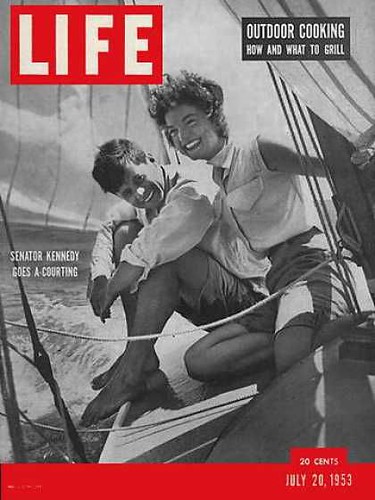
In the meantime, as the world over (ha!) grows in excitement for the premiere of the Kennedy miniseries, I've been meandering through the website's links to Kennedy images. It's image searching that feels slightly more legitimate than usual seeing as how Jon Cassar is asking me to do it and it's not just something I one day decided would be fun to do with some down time. (though the nerdiness implied with the latter never kept me from my fascination before). (This fascination is apparently not a secret since Robyn Modly texted me earlier to ask if Jackie was buried at Arlington National Cemetery, fully expecting me to divulge the details such as the fact that she and John are buried next to their stillborn baby girl, rumored to be named Arabella, and baby Patrick. I did not disappoint).

Thinking about if I would "get on the bus" today has me thinking about if I would've gotten on the bus in 1961. I can't say for certain that I would not have. But I also can't emphatically say I would have.

What I can say with great certainty as I look through these Kennedy images is that there are some magazines I definitely would've had back in the day. I like to think Mom would've surprised me with them as a "happy" the same way she does with People magazines today. Although for $7 a year I could've just had my own subscription.

3620290512_ed5ba9561e

410424_Senator-John-F-Kennedy-with-Jacqueline-and-Caroline

john-f-kennedy-jackie

1101600711_400

50332842

116-012-1900

ejy3uyklwkplkywy
link

pndgyw8766wcw68

!CE-nKeg!Wk~$(KGrHqEOKjUE0l-80uH3BNTsebq(I!~~_3

116-111-2400


look04

look01

116-209-0700


ejyxl55yfw07xy57

look03

85705158

LIFE magazine cover after Kennedy's assassination

50308319

look02

Jacqueline_Kennedy_Her_Personal_Photos

ABuL

ek0462aismxp0k6x

rfk-life-cover-1966

kf16fefb1x9lefbf

50686049

Yeah, I'd have totally bought into the Kennedy mystique.

And yet I spent the week focused on the Freedom Rides and fervently believing in their effort.

The Kennedy's had a complicated relationship with the Civil Rights Movement in general--specifically with James Farmer-- but I cannot discredit the effect of their celebrity on America.

It would be dishonest to consider the sixties without the Kennedys. It would also be dishonest to consider the sixties outside of the impact of events rarely remembered by the magazines.

Somewhere there is a balance. And I am so very thankful for a place where I am actively encouraged to find it.

Saturday, April 2, 2011

She's a Dogwood

DSCN2189

I loved kindergarten.

Mostly I loved my teacher who was pregnant and also had an incubator by which we got to hatch chicks. Score.

Still, for some reason, life seemed so much harder around the corner from preschool. And some days-- just a few times-- I needed my sister. On a handful of occasions (so rare I don't really remember an isolated incident) I trekked on up to the 3rd grade and got to interrupt class to say hello.

She knew me. A hug from the big sister was enough to renew my resolve to be the best kindergartner I could be. Mostly because whatever she did, she was doing all she could to be her best. I used her toothpaste for magic potions, stole perfume from her room and talked her ear off at least once a day. But when I saw her at school-- specifically when I sought her out-- she never disowned me.

At Dr. Martin Luther King Jr. Elementary Interdistrict Magnet School she was my irreplaceable big sister. It seems she's always known on some level or another how much power she has to affect my mood, mind and level of confidence. She very rarely took advantage of that ability (even when I disrespected her property) and rose to occasion when I needed her most. Maybe it's not surprising, then, that I don't remember the specific issues or emotions that drove me to seek her embrace. I only know that she gave it to me.

In all of the pestering, I fear I forgot to tell her just how much that meant. She must've caught on anyway.

It's officially April in Fred Vegas. As we drove the town going to and fro, Emily made mention of the early-blooming Dogwoods. They stand in beautiful contrast to the rest of the trees.

We did a lot in five days. We did dinner with the Modly girls, 5 Alive and lots of Freedom-ridery things. I got to introduce her in class and we introduced "All That" to Claire. We got snacks with Deirdre and milkshakes with Meredith and did a movie with Katie Jones and conversed at La Petite with Dina. We ate too much chocolate with Jill and ate Chipotle on campus walk as college passed by (and I passed out buttons).

DSC_0178

DSCN2125

DSCN2175

DSCN2176

We pondered things. We had fun. We hugged.

DSC_0015

And over and over again I looked to her and said, "Hey, you're here!" Because, friends, I don't know what I did to get to be the girl with a sister who uses her power to affect things so effectively-- who would make a trip to encourage me and take deeper interest in my life. And in taking interest in my life, wanting to encourage the people around this place who make me who I am.

DSC_0026

A visit from her is enough to renew my resolve to be the best college student I can be...just like the kindergarten days. She is my sister-- one who stands in beautiful contrast amongst the rest.

DSCN2186

And I love her.

(she saved me from this)

DSC_0156

(I'm a lot more corners from preschool these days) (you might not be able to tell) (but she still came all the way to see me) (i'm failing at my goal to consolidate parenthetical content)

To quote Katie Jones, "here's a song!"


Tuesday, February 8, 2011

Buses are a' comin'

DSC_0411

Today was the kick-off event for our semester long celebration of the 50th anniversary of theFreedom Rides organized by UMW's very own James Farmer.

DSC_0405


DSC_0448
------------------------------------------------------
Around lunchtime, rumors began swirling.

They planned to encircle the entire high school building and prevent us from leaving.

Those of us considered lesser. Less accomplished, less learned, less worthy.

Those of us considered less.

This was discrimination. One of my only real experiences with it.

I was at the mercy of my senior classmates. And their water guns and balloons.

Even that was shockingly frightening. We were scared to exit the building that day. They only had water. Those "wounds" healed about at quickly as it took my collared shirt to dry-- the duration of my carpool ride home. And it wasn't really discrimination-- they were just having a little fun practicing their seniority one last time.

-----------------------------------------------------

Some wounds run deeper.

I didn't inflict them, they aren't my fault and since I'm not responsible I shouldn't have to apologize for them. I wasn't at the lunch counters or surrounding the bus stations. I wasn't shouting death threats or picking up lead pipes. I was neither the oppressed nor the oppressor.

This is a new era.

That much I know to be true.

I also know that a great amount of the argument for color-blindness-- the idea that we'll put aside race altogether, forget skin color and consider each other no different-- is good. We've generally reached the point in this country when we're just sick and tired of racism. We're tired of being accused of it, we're tired of watching it in practice.

We want the dream. We want this chapter to be closed.

We want to wash our hands of the iniquity that split this country and Woolworths down the middle. And it was sin. The hatred was sin.

"8 If you really keep the royal law found in Scripture, “Love your neighbor as yourself,” you are doing right. 9 But if you show favoritism, you sin and are convicted by the law as lawbreakers. 10 For whoever keeps the whole law and yet stumbles at just one point is guilty of breaking all of it.

...

12 Speak and act as those who are going to be judged by the law that gives freedom, 13because judgment without mercy will be shown to anyone who has not been merciful. Mercy triumphs over judgment."

(James 2:8-10, 12-13)

Maybe some didn't know it to be sin. After all, all they knew was what they knew-- and that was segregation. Story after story, white southerners come forward to say, "I didn't know better."

Many don't come forward because they fear they won't be believed at their word. They fear they will be met with "How couldn't you have known? When you saw the beatings and the blood and you heard the suppression of peace songs, of God songs, how could you have missed it?" They feel they'll be accused before they are able to give witness. They feel shut down, possibly even ashamed, and they aren't looking for more shame at the hands of people who they believe will inevitably respond with bitterness. Instead, they let the guilt they feel accused of fester, until they've come up with a defense. I didn't do anything to you, how dare you accuse me, why do you keep making this an issue?

On the other side-- in the 60's dubbed the integrationists, or agitators or negro-lovers-- a counter-argument brews. You made this an issue first. When you made the signs and nailed them to your businesses, when you shut down schools rather than have black students, when you burned down buses rather than let black men and women-- boys and girls, really-- through your state, you made it an issue.

DSC_0436

When you bombed the churches and killed the school girls and shot our leaders, the men standing in the gap, you made it an issue.

Then the rebuttal. I wasn't there, I didn't do those things, and I resent that you'd make that accusation.

And in the back and forth, an answer of grace:

I'm not saying you did it. Put your pride aside. This isn't about you. I'm not mad at you. I'm mad that I couldn't hold a meeting in a church or bus terminal without fearing my life upon my exit. Not at you. At it. Mad that it happened. Not accusing you. Just wishing someone would acknowledge that it happened. Wishing the oppressors would admit they were wrong, not just declare us moved on. I'm hurt. You're hurt. We all have an opinion on these things. I'm sick and tired of feeling deeply about these things but the different sides not talking through this for fear of judgment and accusation from the other side. Let's lay our pride down. Me first. I'll say I'm sorry you felt prematurely judged, accused. I don't mean to make you feel responsible. I just want you to know. I want to be known. And you? Don't you want to tell your side? Don't you want me to know your story? The story of your life and why you felt these things were okay? I'm willing to listen. Not talk. Just listen.

I want to know you. I want to love you. If the sixties were a time of oppressor v. oppressed, I don't wish for a reversal of roles. I don't mean to harbor bitterness in an effort to achieve betterness or hold on to an attitude of superiority. I don't want to make this an issue or raise my voice. I don't want special treatment or a handout. I just want to be known, loved.

------------------------------------------------------

I was a junior in high school. Scared of my own classmates, friends with their water pistols.

I can't imagine the fright of the junior in college, surrounded by fully grown men with bulletpistols.

DSC_0325

And I can imagine why she wants me to know her story. I can imagine why she might want someone to acknowledge that that was never okay. She's not trying to pester or agitate. She just wants me to think. She wants me to understand. And she wants me to move on. Move forward. The image of the prison matrons of Parchman (the most notorious maximum security prison in the country at the time) will not unburn itself from her memory. The smell of pinesol and the feeling of abrasive vaginal exams wont erase from her mind.

DSC_0446

She's not making this an issue, it is an issue.

It is her story and it is littered with injustice. Not an exaggeration or sob story. She doesn't want my pity. She wants my respect. She deserves my respect. She isn't perfect. She knows that. And I can know that she isn't perfect, I can know it's not my fault she experienced what she did and still look into her deep blue eyes and say, "I'm sorry."

DSC_0429

Funniest thing. When I do that, I get what most white southerners yearn to hear as they make their defense against a presumed accusation of racism. "Oh, well. It's not your fault."

DSC_0326

From the Reverend, once a 21-year-old sophomore in Richmond who got on a bus headed south in the name of freedom, just a piece of advice. He speaks in the imperative. "You just have to find something you are passionate about and do it. Get on your bus."

DSC_0444

Later, after I've thanked him for being here today, for sharing his story even now, 50 years later, he sings. On stage, on the spot, the songs that carried a movement. In jail cells, their matresses were taken away as punishment for singing. Joan says it made for better acoustics.

One of the most striking things is their sense of humor.

Oh freedom, oh freedom, oh freedom over me And before I'd be a slave I'll be buried in my grave And go home to my Lord and be free

He sings it from the stage as I watch from across the room. He looks over and I can tell he remembers me from the meet and greet session earlier today. For a moment he stares into my soul and I let him. I sing along and keep contact. He respects my story and I respect his.

DSC_0333

These riders aren't here for international acclaim. Mary Washington isn't exactly the place to come for that, anyway, if you know what I mean. They deserve it, and the institution will do its best to recognize that. But. This is about honoring their legacy. Honoring their boldness and courage. Not an exaggeration or a sob story. People who stepped on a bus with trembling hands and voices still moved to sing.

They aren't trying to make me feel guilty. They aren't imparting to me a need to return to the bitterness of 1961 or rallying me around the cause of the black person during the civil rights movement. Indeed, that time has passed. And though it is etched in their memories and carved into their own being, they don't wish the anger on me.

They don't want it for themselves.

They do want me to know the power in numbers. The joy that is possible in the worst strife. The importance of practicing what I believe. Of finding some injustice-- human trafficking, inner city school conditions, poverty, abandonment-- and getting on a new bus.

They aren't fooled. It's 2011 and they know it. They feel every bit of the passing of time. They see that a man born the year of these rides is now president. They see that he's black-- and though he'll have to own his own merit politically, the possibility of a "Negro" in the White House felt so impossible from a jail cell in 1961. His election, whether we whites want to acknowledge it or not, is a triumphant moment. The principle of which King, Lewis, Nash, Farmer, Green, Mulholland, R.Kennedy and literally countless others lived and died for. Not for him, but for his opportunity.

I have a lot of love for black people. It reaches levels of jest when I bust out my "ghetto" accent or express such delight when songs like "Lift Every Voice and Sing" come on in the car.

But it isn't really a joke. I don't want my appreciation to be mistaken as mockery.


I really believe in King's dream. Sure, the tactics of my elementary school to bring about such a belief are at times hilarious and laughable.

DSC_1059

But they succeeded in one thing that I am forever grateful for: they imparted empathy into my very young heart. They said "hey, Sadie, you are every bit as worthy of opportunity as Courtland is. Cecil, the girl who throws up on the carpets all the time and Joe, the bully aredifferent from you. But they are not better and neither are you. Every one of you in this classroom, regardless of race or background, are capable of being great."

Okay, they didn't put the descriptions of the kids in there. But they really did bring race and background into the conversation. So that I could know that racism was an issue, that it historically did make a difference, and so I could know that that wasn't okay and I should love everyone regardless of the past.

Even regardless of the bitterness that people on both sides hold onto.

That will fade with time, the bitterness. It just can't last.

Love conquers all.

There goes the idealism in me. But it isn't just Dr. King's dream. It is the Word of God. And according to His word, segregation shouldn't have ever happened.

But it did. We can't change that now, black or white. And there is no longer a physical bus to get on in order to show our solidarity. If there was, I'd be on it in a heartbeat, no doubt.


Which is easy for me to say today because a heart of empathy isn't punishable by a punch or beating or a prison sentence in 2011. For that, I do owe a debt of gratitude to the students who were willing to take both, willing even to accept death for the right to empathize with freedom in 1961.


Mostly, though, if a heart of superiority or betterness is a sin, it is committed first and foremost to God. He is the first to apologize to, which is easiest because we can be assured that he won't hold on to accusations.

3 For I know my transgressions,
and my sin is ever before me.
4 Against you, you only, have I sinned
and done what is evil in your sight,
so that you may be justified in your words
and blameless in your judgment.
5 Behold, I was brought forth in iniquity,
and in sin did my mother conceive me.
6 Behold, you delight in truth in the inward being,
and you teach me wisdom in the secret heart.
(Psalm 51:3-6)

We are then forgiven. We can apologize to those still hurting from a hurtful time. We can spread the forgiveness as we hold fast to the Word of God and embark to hear other people's stories. As a Christian, I feel responsible for being at the forefront of that movement. The one that says to society, I am sorry that if in my service to God I've neglected to humble myself to be a servant of man, that you might see the humility of a person truly forgiven of their sins.

Not responsible for the wounds or the beatings or the scars. Not even alive in 1961.

But alive in 2011. And, in being alive, affected. And, affected, wanting to help. And, in wanting to help, willing to say "I'm sorry." Willing to put aside pride. Wanting no glory, just wanting to love God and love people.

That's not even black civil rights specific, and neither does your mission have to be.

I'm not just a lover of Negro spirituals or all things black history for the sake of a hobby.

I love it because I like stories of courage and humility.

Of love, not glory.

I like them because they affect me, make me feel like I'm living in the shadow of great legacy, in a time of great opportunity.

DSC_0340

I like black history and music because it reminds me to love God first, and in a way that will reflect love to his people.

Could I?

DSC_0363

They remind me that I am to be an agent of peace in a bickering world.

DSC_0439

The buses came, the buses went.

History.

DSC_0364

There are new buses.

Will you?

DSC_0437